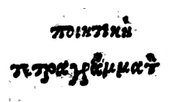
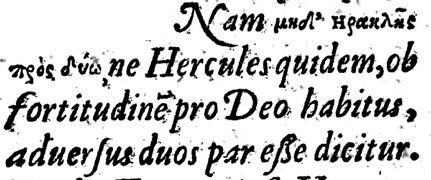
I am translating a Latin manuscript that employs a Greek word now and again, but I am having trouble making out the letters as it is a photocopy of an old manuscript and I am quite unfamiliar with Greek. So far these two words (which I have isolated from the manuscript itself) are very vexing. I would be very appreciative if someone could even just spell them for me; I can do the rest!
Descriptos animadverti tres Horizontes, Horizontem, inquam, temporis, et infinitae aeternitatis: Horizontem aeternitatis temporalis: Horizontem mundi super supremi, qui omnes desinant in EN SOPH, a quo usque ad hominem sint 50 intelligentiarum portae, unde vis quaedam admirabilis in voces emanet, omnipotentiae divinae radius quispiam singularis, virtus ποιητικὴ in nos ab Angelis administris deducta.
And here is my very hasty and error-ridden first-draft style translation:
“I observed an arrangement of three Horizons, the Horizon, I say, of time, and of infinite eternity: the Horizon of temporary eternity: and additionally the Horizon of the highest world, and all three come to an end in Ein Sof, from which all the way to mankind are fifty doors of understanding, whence a certain strange power emanates into voices, an extraordinary ray of divine omnipotence, a poetic virtue conducted into us by the attendant angels.”
I think the second is definitely correct, and here is its sentence and my hasty translation:
“Sensus nonnullos, in dictis quibusdam sacris, praesertim vero in nomine Dei יהוה quod τετραγράμματον vocat, latere didici.”
“I learned to conceal several senses, in certain spoken mysteries, especially in the name of God יהוה which one calls tetragrammaton.”
“Sensus nonnullos … latere didici.” Won’t this mean not "I learned to conceal several senses” but “I have learnt that quite a number of meanings lie hidden beneath the surface”?
(And vocat can hardly mean “one calls”: “he calls”? vocatur, vocant?)
I’m sure you’re correct! I am new to Latin, and here did not detect that indirect statement business, where the “subject” of the statement (in this case “sensus nonnullos”) is in the accusative case, and the verb is an infinitive. I am curious how you detected it!
Here is another mystery for me, along with the sentence (the proper translation to which I hope depends on the identification of these words, one of which looks something like “Ηρακλής”)
Something like “not even Hercules fights against two foes at once.”
μηδ’ Ηρακλῆς πρὸς δύω, proverbial, “not even Heracles [could prevail] against two.” (δύω would more correctly be written δύο.) The Latin translates it. Not even H. is a match for two opponents.