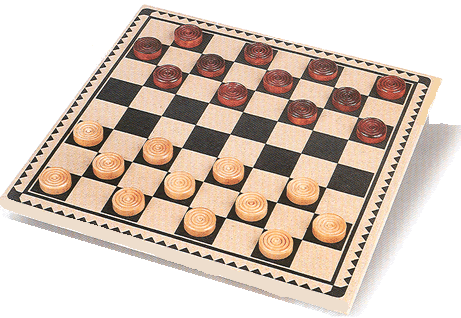
As far as I understand, the original meaning of the word latrunculus is an unknown game. There is a bunch of different phrases in different dictionaries, e.g. lusus latrunculorum, lusus latruncularius, lusus scacchorum, scacci, ludus latrunculorum etc. Very confusing. So my question is - what would be the best name/phrase to use for chess in Latin?
“Many countries lay claim to the invention of chess. It is presently thought that the game originated in India,[2] since the Persian word for chess, shatranj, is derived from the Sanskrit chaturanga, i.e. “four divisions of the military”, infantry, cavalry, elephants and chariots, represented respectively by pawn, knight, bishop and rook.”
For International Chess or Western Chess, as it is called to distinguish it from other variants, we might say “Latrunculi Internationales” or “Latrunculi Occidentales/Occidentis.”
(Remember that a game being played goes into the ablative.)
When chess came to Germany, the chess terms for “chess” and “check” entered the German language as Schach. But Schach was already a native German word for “robbery”. As a result, ludus latrunculorum was often used as a medieval Latin word for “chess”.
“When chess came to Germany, the chess terms for “chess” and “check” entered the German language as Schach. But Schach was already a native German word for “robbery”. As a result, ludus latrunculorum was often used as a medieval Latin word for “chess”.”
Well, latrunculi is the modern Latin word for “chess,” and that’s pretty much it. You could easily call chess “little horsey game” if you wanted — but most people wouldn’t understand you.
Why can’t we just adapt the original Persian name to Latin? I know that is breaking the rules, but latrunculi just doesn’t sound right, I mean, it doesn’t make a lot of sense: what does “thief” or “mercenary” have to do with chess? I prefer the italian word scacchi be used:
“scacchi (dal provenzale escac, che deriva a sua volta dal persiano Shah = re)”
Aye, Roberte, modern Latin, such I use to communicate with others on a daily basis, by means of my blog or the Colloquia fora, exempli gratia. As you know, Latin has a tradition going back two and a half thousand years, and the model for modern Latin is the classical Latin of Cicero — just as modern Hebrew is modelled after classical Biblical Hebrew, and modern Italian is based on the classical Italian of Petrarch and Dante.
As for the game of latrunculi that the Romans played, it differed greatly both from today’s checkers and chess. I enjoy playing ludus latrunculorum Romanus with friends on occasion. As the chess as we know it today came into Europe after the Romans, the name latrunculi was given to the now game that superceded the old one. Thus modern Latin retains latrunculi as the name for modern chess.
However, this Vicipaedia article offers some flexibilty:
Verbis classicis ludus et dicitur “regius ludus,” “regum ludus,” et > saepissime “latrunculi.”
This is directly comparable to what we do in English for the reverse. We call latrunculi “Roman chess.” Igitur Latine dicamur oportet “ludum internationalem latrunculorum” quod chess Angli dicunt.
Modern Latin is not formalized by any institution, despite the Vatican trying to do so. While much of Neo-Latin (Renaissance Latin) was modeled after Cicero, not all of it was, and there were some objectors to that standard, such as Montaigne, Erasmus, Lipsius, and Bacon. The debate is ancient, though, going back to Quintilian and his feud with Seneca the Younger, who took up the Oriental style in opposition to Ciceronian Latin.
I find it absurd that Cicero remains a model for this day, and that usually is due to a faulty comprehension of all Latin prose. How many budding classicists are thoroughly well-read in the Classics prose? There were even marked differences between Quintilian, the defender of Cicero, and Cicero himself.
I still don’t find the argument for latrunculi to be very convincing. Why does Latin have to take the name from the German word for robber? And if it can take words from German, why not Italian (schacci) or Greek (zatrikion)?
You should see Russian! It has numerous acronyms, but will often use the full names, much longer than anything I’ve seen in Latin.
Don’t be lazy.
Ludus latrunclorum is equal to “the game of chess.” That’s only a couple extra syllables, but two fewer words than the English! Also, Latin is a much more explicit language than English or Spanish, inherently. Things are spelled out more clearly, in ancient times as well as these.
You are of course welcome to put together acronyms and decline them — if they catch on, you’ve succeded.
And you question the use of “robbers” — that’s exactly what “latro” or “latrunculus” means.
Yeah, but, if I understand correctly, the word shah (meaning king) that many countries adopted for the game of chess was introduced into the German language as Schach, which already meant “robber.” Then it was translated into Latin as latrunculi. Why did German take precedence here over Persian or Greek?
Oh, and it’s not that I’m lazy, it’s just that it sounds horrible!
Horrible! “Scacci” sounds horrible! and very unlatin.
So I’m not sure if you’ve followed what I’ve attempted to explain. I apologize; I must not have been clear. Romans had latrunculi. As Roman latrunculi faded away, modern chess became popular in Europe. Europeans called the new chess “latrunculi” in Latin — same as the old game.
The appropriateness of the German connexion is tangential.