I’m trying to reconcile the seemingly contrasting elements found in the description ὑπερήφανον καὶ σεσηρότι γέλωτι μικρὸν ὑπομειδιῶσα. My understanding is that σεσηρότι γέλωτι would imply an open mouthed grin whereas ὑπομειδιῶσα modified by μικρὸν would suggest a subdued smile. Is this maybe describing an elusive ‘Mona Lisa’ type smile, coming from a goddess as it is - or have I just misread something (more than likely).
Maybe something like this?

Gerrit van Honthorst - Smiling Girl, a Courtesan, Holding an Obscene Image - 63-1954 - Saint Louis Art Museum
Gerard van Honthorst, Public domain, via Wikimedia Commons
By the way, wouldn’t ὑπερήφανον refer to δαίδαλμα?
I’m reasonably certain its adverbial modifying ὑπομειδιῶσα ?
I also think this particular young lady is smiling φαιδρά rather than ὑπερήφανον 
In theory its describing something like this (The Colonna Venus (Vatican Museums 812)) but maybe σεσηρότι γέλωτι is over-egging it. 
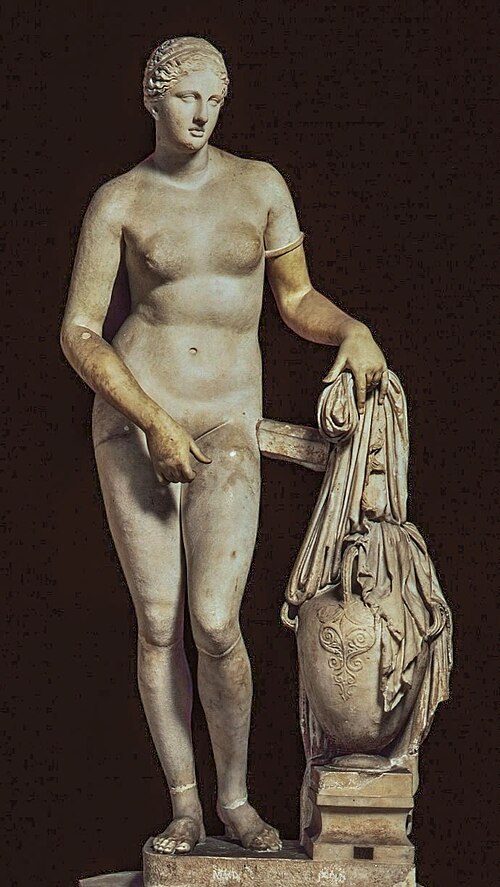
I now think you’re correct about ὑπερήφανον, I didn’t spot it had a less common meaning ‘splendid, magnificent’ which would compliment κάλλιστον. I think the editorial ‘dash’ placement might be misleading in this regard. And if μικρὸν was adverbally modifying σεσηρότι then it could be something like ‘subtly smiling with a slightly parting grin’
As I read it, Παρίας δὲ λίθου δαίδαλμα κάλλιστον is meant as a self-contained parenthetical phrase fairly objectively describing the sculpture as an artwork, while ὑπερήφανον καὶ σεσηρότι γέλωτι μικρὸν ὑπομειδιῶσα moves on to a description and interpretation of the goddess’s smile. ὑπερήφανον must surely be understood adverbially with ὑπομειδιῶσα, in tandem with σεσηρότι γέλωτι μικρὸν. But to properly understand the intended connotation of the descriptors (especially σεσηρότι) we’d need to apply earlier textual comparanda.
And this is an ecphrasis. The sculpture it purports to describe is an imaginary one.
As I read it, Παρίας δὲ λίθου δαίδαλμα κάλλιστον is meant as a self-contained parenthetical phrase fairly objectively describing the sculpture as an artwork, while ὑπερήφανον καὶ σεσηρότι γέλωτι μικρὸν ὑπομειδιῶσα moves on to a description and interpretation of the goddess’s smile. ὑπερήφανον must surely be understood adverbially with ὑπομειδιῶσα, in tandem with σεσηρότι γέλωτι μικρὸν. But to properly understand the intended connotation of the descriptors (especially σεσηρότι) we’d need to apply the earlier textual comparanda.
And this is an ecphrasis. The sculpture it pretends to describe is an imaginary one.
It’s supposedly describing Praxiteles’ Aphrodite at Cnidus, though I accept there could be artistic licence thrown in. That said replicas were presumably pretty ubiquitous during Lucian’s time (i.e. Colonna Venus) so the facial expression would presumably have been known to a good portion of contemporary readers. Stylistically ὑπερήφανον does feel better pairing with σεσηρότι γέλωτι μικρόν to modify ὑπομειδιῶσα.