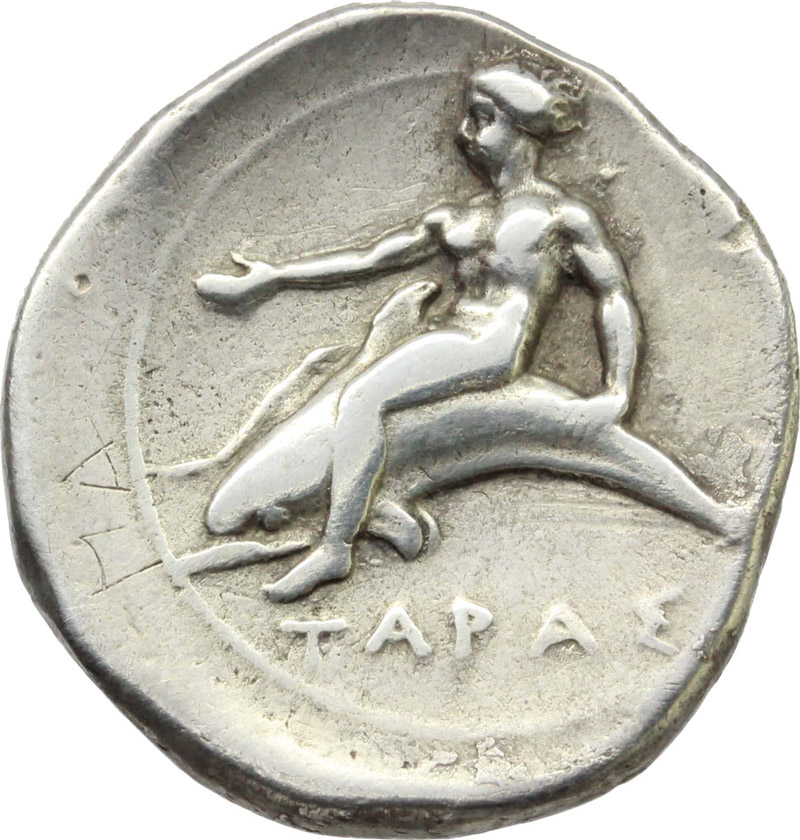
Visiting the Museum Island in Berlin a couple of weeks ago I saw several coins from Taras (southern Italy) with a man riding a dolphin, which immediately brought Herodotus’ account of Arion to my mind. In the story, Arion is sailing on a ship when his crew decide to take his money and throw him to the sea. Once in the sea, however, a dolphin rescues him and he is able to ride it to the shore.
Here’s the story, from Perseus:
τοῦτον τὸν Ἀρίονα λέγουσι, τὸν πολλὸν τοῦ χρόνου διατρίβοντα παρὰ Περιάνδρῳ ἐπιθυμῆσαι πλῶσαι ἐς Ἰταλίην τε καὶ Σικελίην, ἐργασάμενον δὲ χρήματα μεγάλα θελῆσαι ὀπίσω ἐς Κόρινθον ἀπικέσθαι. [2] ὁρμᾶσθαι μέν νυν ἐκ Τάραντος, πιστεύοντα δὲ οὐδαμοῖσι μᾶλλον ἢ Κορινθίοισι μισθώσασθαι πλοῖον ἀνδρῶν Κορινθίων. τοὺς δὲ ἐν τῷ πελάγεϊ ἐπιβουλεύειν τὸν Ἀρίονα ἐκβαλόντας ἔχειν τὰ χρήματα. τὸν δὲ συνέντα τοῦτο λίσσεσθαι, χρήματα μὲν σφι προϊέντα, ψυχὴν δὲ παραιτεόμενον. [3] οὔκων δὴ πείθειν αὐτὸν τούτοισι, ἀλλὰ κελεύειν τοὺς πορθμέας ἢ αὐτὸν διαχρᾶσθαί μιν, ὡς ἂν ταφῆς ἐν γῇ τύχῃ, ἢ ἐκπηδᾶν ἐς τὴν θάλασσαν τὴν ταχίστην: [4] ἀπειληθέντα δὴ τὸν Ἀρίονα ἐς ἀπορίην παραιτήσασθαι, ἐπειδή σφι οὕτω δοκέοι, περιιδεῖν αὐτὸν ἐν τῇ σκευῇ πάσῃ στάντα ἐν τοῖσι ἑδωλίοισι ἀεῖσαι: ἀείσας δὲ ὑπεδέκετο ἑωυτὸν κατεργάσασθαι. [5] καὶ τοῖσι ἐσελθεῖν γὰρ ἡδονὴν εἰ μέλλοιεν ἀκούσεσθαι τοῦ ἀρίστου ἀνθρώπων ἀοιδοῦ, ἀναχωρῆσαι ἐκ τῆς πρύμνης ἐς μέσην νέα. τὸν δὲ ἐνδύντα τε πᾶσαν τὴν σκευὴν καὶ λαβόντα τὴν κιθάρην, στάντα ἐν τοῖσι ἑδωλίοισι διεξελθεῖν νόμον τὸν ὄρθιον, τελευτῶντος δὲ τοῦ νόμου ῥῖψαί μιν ἐς τὴν θάλασσαν ἑωυτὸν ὡς εἶχε σὺν τῇ σκευῇ πάσῃ. [6] καὶ τοὺς μὲν ἀποπλέειν ἐς Κόρινθον, τὸν δὲ δελφῖνα λέγουσι ὑπολαβόντα ἐξενεῖκαι ἐπὶ Ταίναρον. ἀποβάντα δέ αὐτὸν χωρέειν ἐς Κόρινθον σὺν τῇ σκευῇ, καὶ ἀπικόμενον ἀπηγέεσθαι πᾶν τὸ γεγονός. [7] Περίανδρον δὲ ὑπὸ ἀπιστίης Ἀρίονα μὲν ἐν φυλακῇ ἔχειν οὐδαμῇ μετιέντα, ἀνακῶς δὲ ἔχειν τῶν πορθμέων. ὡς δὲ ἄρα παρεῖναι αὐτούς, κληθέντας ἱστορέεσθαι εἴ τι λέγοιεν περὶ Ἀρίονος. φαμένων δὲ ἐκείνων ὡς εἴη τε σῶς περὶ Ἰταλίην καί μιν εὖ πρήσσοντα λίποιεν ἐν Τάραντι, ἐπιφανῆναί σφι τὸν Ἀρίονα ὥσπερ ἔχων ἐξεπήδησε: καὶ τοὺς ἐκπλαγέντας οὐκ ἔχειν ἔτι ἐλεγχομένους ἀρνέεσθαι. [8] ταῦτα μέν νυν Κορίνθιοί τε καὶ Λέσβιοι λέγουσι, καὶ Ἀρίονος ἐστὶ ἀνάθημα χάλκεον οὐ μέγα ἐπὶ Ταινάρῳ, ἐπὶ δελφῖνος ἐπὲων ἄνθρωπος.
They say that this Arion, who spent most of his time with Periander, wished to sail to Italy and Sicily, and that after he had made a lot of money there he wanted to come back to Corinth. [2] Trusting none more than the Corinthians, he hired a Corinthian vessel to carry him from Tarentum.1 But when they were out at sea, the crew plotted to take Arion’s money and cast him overboard. Discovering this, he earnestly entreated them, asking for his life and offering them his money. [3] But the crew would not listen to him, and told him either to kill himself and so receive burial on land or else to jump into the sea at once. [4] Abandoned to this extremity, Arion asked that, since they had made up their minds, they would let him stand on the half-deck in all his regalia and sing; and he promised that after he had sung he would do himself in. [5] The men, pleased at the thought of hearing the best singer in the world, drew away toward the waist of the vessel from the stern. Arion, putting on all his regalia and taking his lyre, stood up on the half-deck and sang the “Stirring Song,”2 and when the song was finished he threw himself into the sea, as he was with all his regalia. [6] So the crew sailed away to Corinth; but a dolphin (so the story goes) took Arion on his back and bore him to Taenarus. Landing there, he went to Corinth in his regalia, and when he arrived, he related all that had happened. [7] Periander, skeptical, kept him in confinement, letting him go nowhere, and waited for the sailors. When they arrived, they were summoned and asked what news they brought of Arion. While they were saying that he was safe in Italy and that they had left him flourishing at Tarentum, Arion appeared before them, just as he was when he jumped from the ship; astonished, they could no longer deny what was proved against them. [8] This is what the Corinthians and Lesbians say, and there is a little bronze memorial of Arion on Taenarus, the figure of a man riding upon a dolphin.
The coins looked like this (a random image found by googling): https://static.deamoneta.com/auctions/487/thumbs/34R.jpg
There seems to be some connection here, between the coins and the story…
 > , which may have been dedicated by the poet; Pausanias (iii. 25. 5) saw it, and supports H.'s account by the story of the dolphin of Poroselene. The Taenarum monument bore the inscription ἀθανάτων πομπαῖσι Ἀρίονα Κυκλέος υἱὸν Ἐκ Σικελοῦ πελάγους σῶσεν ὄχημα τόδε, Ael. H. A. xii. 45. A small figure of this kind was actually found at Taenarum (Frazer, u. s.).