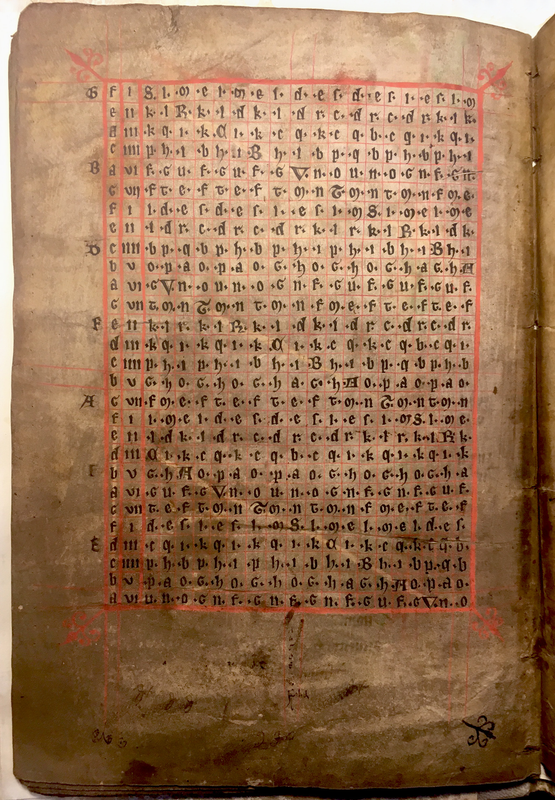
Well, there is no text so there is not much to translate. This is just a table to find the date of Easter for any year in the Julian calendar.
G	f	1	S.	l·	·m	·e	l·	·m	·e	l·	d·	·e	s·	d·	·e	s·	l·	·e	s·	l·	·m
	e	2	k·	·l	R.	k·	·l	·d	k·	·l	·d	r·	c·	·d	r·	c·	·d	r·	k·	·l	r·
	d	3	·k	q·	i·	·k	.C	i·	·k	·c	q·	·k	·c	q·	b·	·c	q·	i·	·k	q·	i·
	c	4	p·	h·	·i	·b	h·	·i	.B	h·	·i	·b	p·	·q	·b	p·	h·	·b	p·	h·	·i
B	a	6	f·	·g	u·	f·	·g	u·	f·	·g	V.	n·	·o	u·	n·	·o	·g	n·	f·	·g	n·
	g	7	·f	t·	e·	·f	t·	e·	·f	t·	m·	·n	T.	m·	·n	t·	m·	·n	·f	m·	e·
	f	1	l·	d·	·e	s·	d·	·e	s·	l·	·e	s·	l·	·m	S.	l·	·m	·e	l·	·m	·e
	e	2	·l	·d	r·	c·	·d	r·	c·	·d	r·	k·	·l	r·	k·	·l	R.	k·	·l	·d	k·
D	c	4	·b	p·	·q	·b	p·	h·	·b	p·	h·	·i	p·	h·	·i	·b	h·	·i	.B	h·	·i
	b	5	o·	·p	·a	o·	·p	·a	o·	g·	·h	o·	g·	·h	o·	g·	·h	·a	g·	·h	.A
	a	6	·g	V.	n·	·o	u·	n·	·o	·g	n·	f·	·g	n·	f·	·g	u·	f·	·g	u·	f·
	g	7	t·	m·	·n	T.	m·	·n	t·	m·	·n	·f	m·	e·	·f	t·	e·	·f	t·	e·	·f
F	e	2	k·	·l	r·	k·	·l	R.	k·	·l	·d	k·	·l	·d	r·	c·	·d	r·	c·	·d	r·
	d	3	·k	q·	i·	·k	q·	i·	·k	.C	i·	·k	·c	q·	·k	·c	q·	b·	·c	q·	i·
	c	4	p·	h·	·i	p·	h·	·i	·b	h·	·i	.B	h·	·i	·b	p·	·q	·b	p·	h·	·b
	b	5	g·	·h	o·	g·	·h	o·	g·	·h	·a	g·	·h	.A	o·	·p	·a	o·	·p	·a	o·
A	g	7	·f	m·	e·	·f	t·	e·	·f	t·	e·	·f	t·	m·	·n	T.	m·	·n	t·	m·	·n
	f	1	l·	·m	·e	l·	d·	·e	s·	d·	·e	s·	l·	·e	s·	l·	·m	S.	l·	·m	·e
	e	2	·l	·d	k·	·l	·d	r·	c·	·d	r·	c·	·d	r·	k·	·l	r·	k·	·l	R.	k·
	d	3	.C	i·	·k	·c	q·	·k	·c	q·	b·	·c	q·	i·	·k	q·	i·	·k	q·	i·	·k
C	b	5	g·	·h	.A	o·	·p	·a	o·	·p	·a	o·	g·	·h	o·	g·	·h	o·	g·	·h	·a
	a	6	·g	u·	f·	·g	V.	n·	·o	u·	n·	·o	·g	n·	f·	·g	n·	f·	·g	u·	f·
	g	7	t·	e·	·f	t·	m·	·n	T.	m·	·n	t·	m·	·n	·f	m·	e·	·f	t·	e·	·f
	f	1	d·	·e	s·	l·	·e	s·	l·	·m	S.	l·	·m	·e	l·	·m	·e	l·	d·	·e	s·
E	d	3	·c	q·	i·	·k	q·	i·	·k	q·	i·	·k	.C	i·	·k	·c	q·	·k	·c	q·	b·
	c	4	p·	h·	·b	p·	h·	·i	p·	h·	·i	·b	h·	·i	.B	h·	·i	·b	p·	·q	·b
	b	5	·p	·a	o·	g·	·h	o·	g·	·h	o·	g·	·h	·a	g·	·h	.A	o·	·p	·a	o·
	a	6	u·	n·	·o	·g	n·	f·	·g	n·	f·	·g	u·	f·	·g	u·	f·	·g	V.	n·	·o
The first two columns use seven letters (A-G) to indicate the last and first day of the year (which are only different in leap years), this is called the Sunday letter.
- A = Sunday
- B = Saturday
- C = Friday
- D = Thursday
- E = Wednesday
- F = Tuesday
- G = Monday
So the first year in the table has the letters “G f” which means it was a leap year starting on “G” = Monday 1 January and ending on “f” = Tuesday 31 December. The year below that has the letter “e” which means it was a common year starting on “e” = Wednesday 1 January and ending also on “e” = Wednesday 31 December.
The next column uses numbers (in Roman numerals I-VII or 1-7) for the concurrent, the concurrent is based on the Sunday letter (only the second Sunday letter counts in leap years) and is one of the variables used to calculate the Easter date. Then the next 19 columns give the Easter dates according to the Julian calendar (which was used since the Roman Empire until the end of the Middle Ages), but the dates are coded as letters preceded or followed by a dot.
After a bit of testing, I found out how the code seems to work. Here is a list of how I believe these codes correspond to the dates:
a· = 21 March
b· = 22 March
c· = 23 March
d· = 24 March
e· = 25 March
f· = 26 March
g· = 27 March
h· = 28 March
i· = 29 March
k· = 30 March
l· = 31 March
m· = 1 April
n· = 2 April
o· = 3 April
p· = 4 April
q· = 5 April
r· = 6 April
s· = 7 April
t· = 8 April
u· = 9 April
·a = 10 April
·b = 11 April
·c = 12 April
·d = 13 April
·e = 14 April
·f = 15 April
·g = 16 April
·h = 17 April
·i = 18 April
·k = 19 April
·l = 20 April
·m = 21 April
·n = 22 April
·o = 23 April
·p = 24 April
·q = 25 April
I have no idea why only 20 letters were used (there was no difference between “i” and “j”, or between “u” and “v” and “w” was seen as a double “u”, but “x”, “y” and “z” existed but were not used in this table). Also, some letters are capitalized, but I have no idea why.
The table goes from top to bottom, from left to right, and gives a cycle of 532 years, so the first Easter date in the list (top left corner) is for the year 76 AD, 608 AD, 1140 AD and so on: all these years have the same easter date. The Easter date for these years is “S.” which is 7 April.
So:
- in the years 76, 608 and 1140, the Easter date was “S.” which is 7 April
- 77/609/1141 - k· - 30 March
- 78/610/1142 - ·k - 19 April
- 79/611/1143 - p· - 4 April
- 80/612/1144 - f· -26 March
- 81/613/1145 - ·f - 15 April
- 82/614/1146 - l· - 31 March
- 83/615/1147 - ·l - 20 April
- …
This method was devised by Dionysius Exiguus in the sixth century in order to make sure all Christians would celebrate Easter on the same day. He was asked to do so because there had been an incident in Rome where two popes had been elected, both claiming to be the only legitimate one, and both accusing the other of celebrating Easter on the wrong date.
In 1582, pope Gregory XIII installed a new calendar (the Gregorian calendar) which since replaced the Julian calendar, so if you want to use Dionysius Exiguus’ method today, you would have to adapt it to the Gregorian calendar. Although there are some Orthodox churches which still use the Julian calendar and Dionisius Exiguus’ calculations today.