I recently found the Textkit forums while searching for additional help and exercises for Athenaze. I have been working my way through Athenaze for a few weeks, taking it slow to be sure I have fully memorized the vocabulary and understood the grammar.
I am not very happy with the way Athenaze introduces verbs. A high level brief overview of the system would have been nice. Also some guidance about principal parts and what to memorize would help.
But on to my simple question.
I am working on chapter 2 of Athenaze and I do not understand the presentation of verbs. The paradigm shows that 1st sing of φιλε- is φιλώ, and says “in Attic Greek you will always see φιλω…”
But the Athenaze dictionary entry lists φιλεω as the 1st sing form.
Also, one example sentence has εγώ πονω, while the very next sentence of explanatory notes shows the word as πονεω.
What is the actual 1st singular form of these verbs?
Welcome to Textkit! Good Luck with Athenaze. I have an older edition, but the most of the text is the same as in later editions.
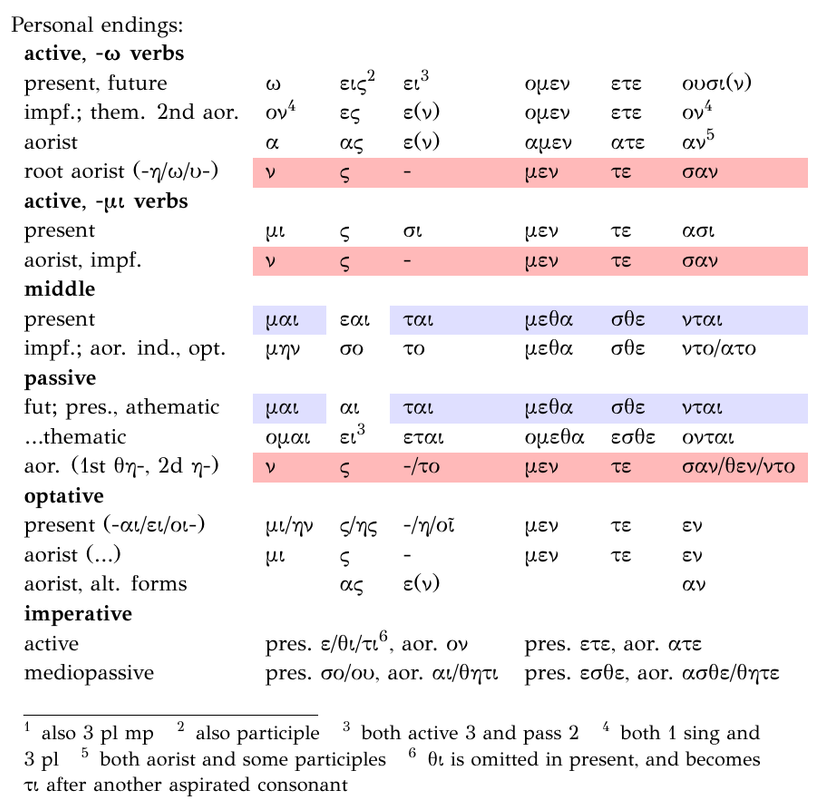
As to your very good question, the reason you’re seeing two forms of the verbs is that many of the verbs you’ll be seeing in Attic have contracted forms. πονέω contracts to πονῶ, φιλέω to φιλῶ. I think the reason that the dictionary or glossary listing shows the uncontracted form is so that you’ll know how to make the proper contracted form for all persons and numbers. For example, φιλῶ which contracts from φιλέω will yield φιλεῖς in the 2nd person sing. and φιλεῖ in the 3rd person sing. If the only uncontracted form was -έω, this might not be a problem, but there are 3! -άω and -όω also contract to -ῶ. Conjugating, say, τιμάω yields: τιμῶ,τιμᾷς,τιμᾷ. Conjugating δηλόω gives us δηλῶ, δηλοῖς, δηλοῖ. There are a few rules for contracting adjacent vowels which you will learn in the coming lessons.
I would just add that I think the reason that the glossary at the end of Athenaze lists the uncontracted form is that this is the form you will find in a standard dictionary. Not all Greek Literature is attic!
In Attic texts you will usually find the contracted forms. In older editions of Athenaze this is explained more fully in chapter 4.
Its always difficult to know how much material to present in the early stages. If you would prefer more information you can always look ahead or look at the paradigms at the back of the book.
Thank you all for the quick responses. I think I understand the concept, and what Athenaze was trying to demonstrate, though you all have given me a much more comprehensible explanation.
I guess learning the uncontracted verb forms is a good idea for me. My ultimate goal is to be able to read the surviving fragments of Ψαπφω and Αλκαιοσ in the original.
Since I’ve been told that no absolute beginner learns the Aeolic dialect, I decided to go with Athenaze and learn Attic to start.