Χαίρετε ῶ φίλοι καὶ φίλαι!
Attic Greek has a lot of vowel contractions. I’m sure we’re all familiar with the most common rules, like anything+ω > ω, οε/εο > ου. But the rarer ones can be a bit tricky.
Descriptions I’ve been able to find online - like this one - are helpful, but they aren’t rigorous enough to predict exact results, and I often consulted this table on Wiktionary. But actually there are a set of exact rules (with just 2 exceptions).
I’m sure that this type of rules is not new at all, and there are likely formulations that are simpler and more grounded in linguistic reality, but since I haven’t found a satisfactory rule set online, I thought I’d post my version here in case some of you find it useful. If you find the rules to be more tedious than just memorizing everything, that’s totally fair too 
Let’s establish a few things first:
- U+V denotes the two vowels being contracted.
- Short α ι υ are unmarked; long ᾱ ῑ ῡ are macronized.
- A lengthened vowel is one of ᾱ, “spurious” ει, ῑ, ου, and ῡ.
- They are lengthened from α ε ι ο υ respectively.
- η and ω are long vowels, but not considered lengthened vowels in this rule set. (Yes I know they are actually lengthened if you go back to PIE. These rules aren’t 100% linguistic reality, diachronic or synchronic.)
This copy of the table on Wiktionary is our starting point. The shaded cells are presumably either totally unattested or too rare for us to worry about. The one cell (η+ο = ω) marked with * is not present on Wiktionary, but is useful for our rules.
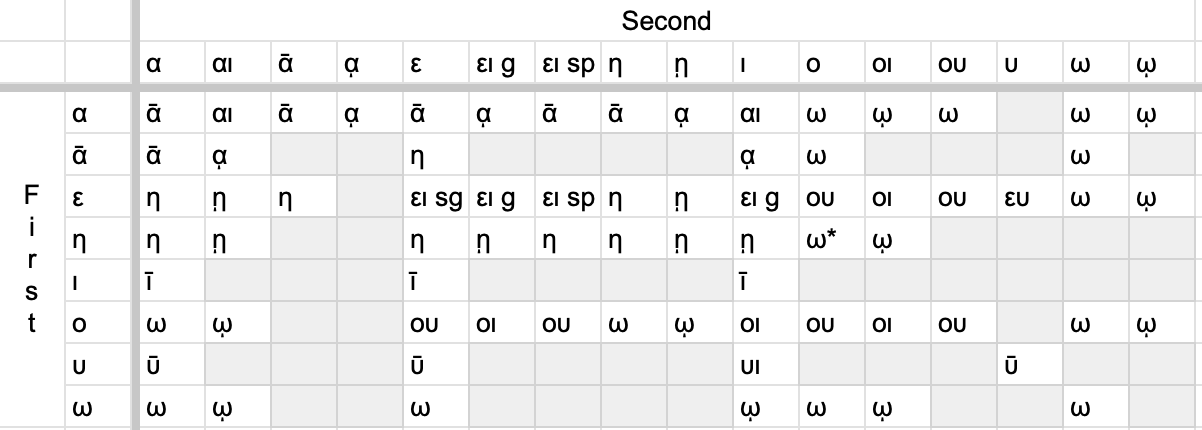
The first two rules deals with ι and υ:
- U+ι and U+υ simply form diphthongs. (In fact, I’m not sure why they even appear in the contraction table in Wiktionary, these two columns are exactly what you’d expect.)
- ι+V and υ+V, when legible, only results in ῑ or ῡ.
The order does matter here, so υι is a diphthong, instead of contracting to ῡ.
Removing the ι and υ columns and rows, we get a slightly simpler table:
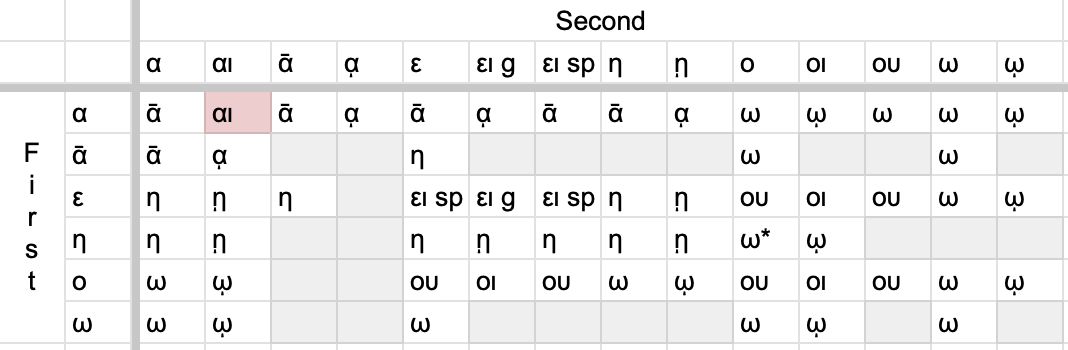
The next two rules reduces the set of V we have to deal with:
- U+V̄ = U+V̌, where V̄ is a lengthened vowel (see above) and V̌ is the unlengthened counterpart. Examples:
- α+ει (spurious) = α+ε = ᾱ
- ε+ᾱ = ε+α = η
- α+ου = α+ο = ω
- U+Vι = (U+V)+ι, assuming that ου+ι = οι and ει+ι = ει. Examples:
- α+ει (genuine) = (α+ε)+ι = ᾱ+ι = ᾳ
- ο+ῃ = (ο+η)+ι = ω+ι = ῳ
- ε+οι = (ε+ο)+ι = ου+ι = οι
- There is one exception: α+αι is not the expected (α+α)+ι=ᾱ+ι=ᾳ, but αι.
Removing all the columns with lengthened vowels and diphthongs, we now get to our final table:
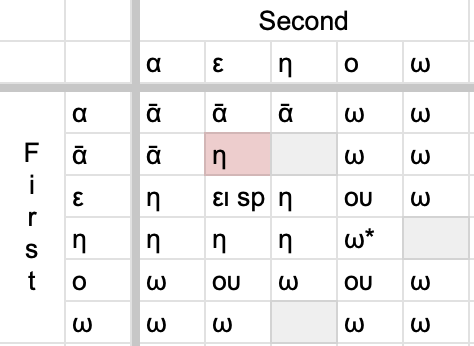
We now need this map of the relative position of these vowels:
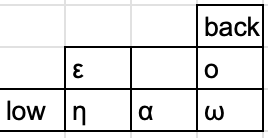
Now, to find U+V, start from U in the map, and move it according to V (the order doesn’t matter):
- If V is a back vowel (ο or ω), move horizontally to the back.
- If V is a low vowel (η, α or ω), move vertically to the bottom.
If you land on α, ε or ο, lengthen to ᾱ, ει or ου. (Don’t worry about the void above α, you’ll never end up there.)
Here’s an alternative, more verbose formulation by enumerating all possible V:
- If V is ε, simply lengthen U. (ε is neither back nor low, so U doesn’t move).
- If V is η or α, lower U and lengthen. (η and α are low, but not back).
- If V is ο, bring U to the back end lengthen. (ο is back, but not low).
- If V is ω, the outcome is ω. (ω is both back and low).
The only exception to these rules are is ᾱ+ε, where we find η instead of the expected ᾱ.
That’s it! I hope some of you find it useful.