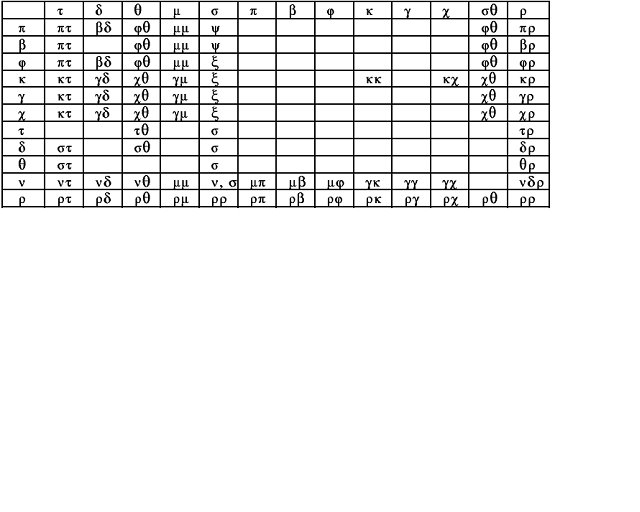
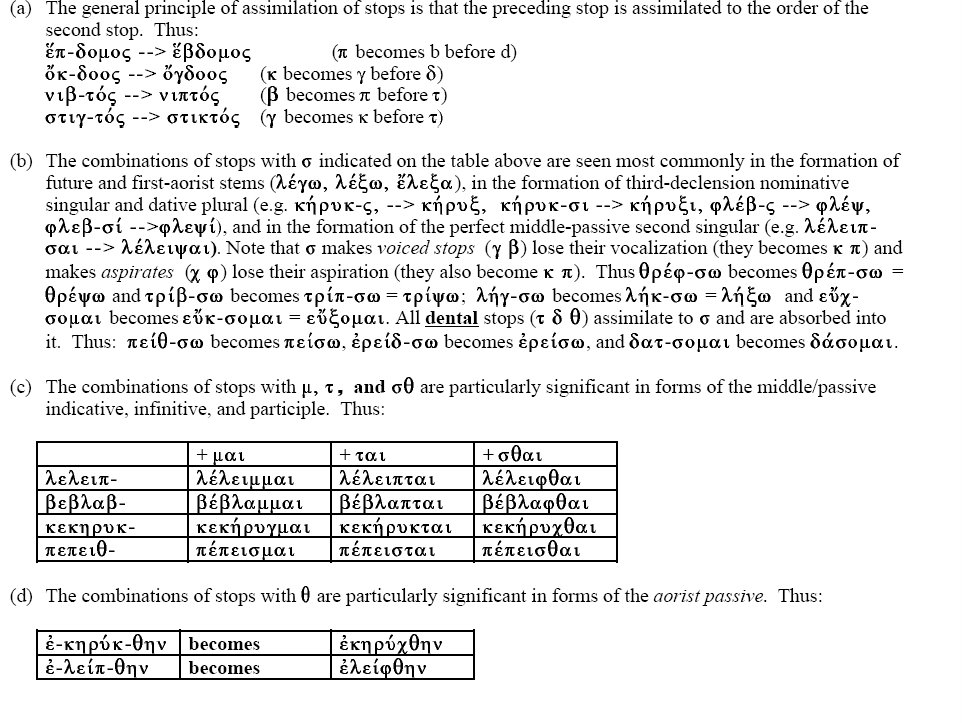
Here we go…
From Allen’s Vox Graeca, 3rd ed., pp35-36 (I omit references to his Vox Latina). Since not everyone will have an IPA font, I will use [N] in addition to the usual IPA [ŋ] (the ng in sing not anger).
"We have already mentioned that, in addition to the dental and bilabial nasals, there was in Greek, as in, for example, English and Latin, a velar nasal sound, occurring before velar plosive consonants, where it is represented by γ — e.g. ἄγκυ?α, ἔγχος, ?γγύς. Varro identified this with the sound of the n in Latin angulus etc., which was clearly a velar nasal (described by Nigidius Figuls as `inter litteram n et g’ and as not involving contact with the (hard) palate). The use of n to indicate this sound, as in Latin, is understandable enough, since the velar pronunciation is automatic before velar plosives; and similar spellings with ν are found in Attic inscriptions (regularly before 5 c., e.g. c. 550 ενγυσ). But the normal Greek spelling with γ for [N] ([ŋ]) is on the face of it remarkable, since it is as though we were to write e.g. English ink, finger as igk, figger. There is nothing in the nature of a velar plosive that would account for the nasalization of a preceding plosive; so that the only logical explanation for such spellings would be if γ had this nasal [N] ([ŋ]) value in some other environment where it was phonetically intelligible; from such a context the writing with γ could then have been transferred to other positions (on the principle, familiar also to some modern schools of phonology, that a given sound must always be allotted to the same phoneme).
The most obvious candidate for providing such an environment is the position before a following nasal, that is, if γμ and/or γν were pronounced [Nm, Nn] ([ŋm, ŋn]) (like the ngm, ngn in English hangman, hangnail), as in the case of Latin magnus etc.
There is in fact a tradition, preserved by Priscian (+Gl, ii, p. 30 K) as ascribed by Verro to Ion (probably of Chios), that the [N] ([ŋ]) sound represented by γ in ἄγκυ?α etc. had a special name in Greek, and that this name was ἄγμα; since the Greek names of letters are otherwise related to the sounds they represent, such a name makes sense only if it is pronounced [aGma] ([aŋma]), that is, if the γ is pronounced [N] ([ŋ]) in the position before the nasal μ."
He then goes on to give the perfect passive examples given earlier.
Interestingly, all three of the authors I consulted — Sihler, Allen, Palmer — say that in the case of -γν- the [ŋn] interpretation might be right, but it’s much less certain.