μεσημβριάς Nonn.D.48.590. and إبصالية واطس للثلاثة فتية القديسين

Herodotus doesn’t have a specific word for “afternoon” – because the exact time of noon could not normally be determined with precision in his world – so he expresses something like the modern English concept as the decline of midday, ἀποκλινομένης δὲ τῆς μεσαμβρίης. Likewise, Aelius Aristides describes places where precise local astronomical noon was pinpointed more or less precisely as unusual natural wonders. Both of these passages illustrate my point: ancient societies weren’t regulated by the precise time measurement that modern clocks make possible, for better or worse.

It’s also worth noting that in Herodotus, as in Nonnus, μεσημβρία is associated with midday heat.

In Bailly I have found δειλη used by Herodotus for afternoon

At least for private arrangements, the present day Egyptians that I have met both here and in other places are not regulated by precise time measurement either. Last year I arranged to have dinner with somebody. I arrived in the vicinity of the restaurant a little before the agreed time. The person had arranged to meet arrived about two and a half hour later. He wasn’t worried by that at all and talked about the things that he had been doing over the past three hours, both planned and which had arisen unexpectedly. On another occasion, before mobile phones became ubiquitous, with a German, I arrived outside the agreed restaurant a few minutes before time and then waited for about 30 minutes. Assuming that something had come up, I ate alone. A few days later, I met the fellow. He explained that he arrived a good half hour before time, and seeing as I had not shown up he left. He felt that 3 minutes before time was late. Precision in measurement may modify things a little, but the underlying assumption that time is a series of events or a series of fixed points doesn’t make a society/ culture ancient or modern.

I am not really sure about the point you are making about there being no need for “afternoon” in ancient societies. I realise you’ve mentioned it 3 times with increasing confidence, but… sorry. Where I live, I woukd describe the people as “traditional”. For them, noon (中午) extends from about 11:30 till about 14:00. It used to be longer, but chairman DXP shortened it at some point. It is a time for eating, resting and not interacting with others. Nobody practices piano or has domestic arguments at that time. It is socially unacceptable to call or call on others. Government offices generally shut, in offices people lay out camp beds and sleep, and students mean forward and sleep on their desks.

Afternoon starts here at about 13:30 in winter and at 14:30 in summer. In Hainan - a island near Vietnam - that I stayed on for a summer, the afternoon starts when the rain stops. I don’t think “precision” based on the movement of the sun matters when people are arranging their daily activities based on the climate and daily weather. People here don’t go out in the rain. Even if they have cars and can drive from the underground car park of their home to the underground car park of the supermarket, they still don’t go out. They stay continue their traditional way of life in touch with the weather despite technology.

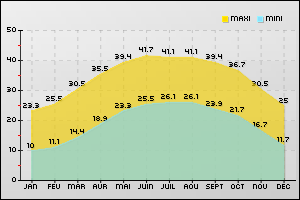
There is seasonal variability.

Data for Aswan Dam.

For them, noon (中午) extends from about 11:30 till about 14:00. It used to be longer, but chairman DXP shortened it at some point. It is a time for eating, resting and not interacting with others. Nobody practices piano or has domestic arguments at that time. It is socially unacceptable to call or call on others. Government offices generally shut, in offices people lay out camp beds and sleep, and students mean forward and sleep on their desks.

What you are describing is a Chinese siesta. This is more or less what μεσημβρία means: not a specific point in time (unlike modern clock-regulated societies) but a vaguely defined midday period during which everyone abstains from strenuous activity, and its origins lie in agricultural work, where the heat of the midday sun makes activity not just difficult but dangerous. "Mad dogs and Englishmen . . . "

And, yes, the heat varies seasonally, but in Egypt, it’s hot all year round, and in any event, agricultural activity is generally concentrated in the hot seasons of the year.

In any case, Nonnus isn’t specifically referring to the weather inupper Egypt. The Dionysiaca is a poem, squarely in the ancient Greek poetic tradition, and he is invoking meteorological conditions prevailing throughout the Mediterranean world and elsewhere (even in China, apparently)at midday, when the sun’s heat dissuades activity and induces torpor. While I haven’t searched for this, you will find many instances in ancient Greek and Latin literature (and elsewhere) where agricultural laborers rest during the hottest hours of the day,

I

have found δειλη used by Herodotus for afternoon

But unlike modern “afternoon”, it’s not a time of day defined specifically to noon, a precise horological or astronomical instant. When Herodotus wants to be more meteorologically precise, he resorts to the phrase ἀποκλινομένης δὲ τῆς μεσαμβρίης, but that’s not a translation of “afternoon”.
Page from LCL.


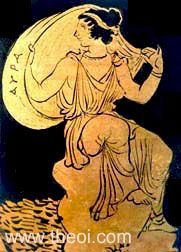
It seems that if the torpor of the heat of the day that is nuanced by μεσημβρία and ظهيرة is present in the meaning of μεσημβριάς, then seeing that she is not an English woman, the culturally nuanced image evoked by μεσημβριὰς is of a swooning almost sun-struck woman running alone outdoors, fighting off her own natural inclination to rest.

the culturally nuanced image evoked by μεσημβριὰς is of a swooning almost sun-struck woman running alone outdoors, fighting off her own natural inclination to rest.

Aure is a demigoddess or nymph, Breeze personified, and she’s seeking a cool place with water and shade to rest in the midday heat.

In this post I want to consider the length of μεσημβρία.

In my opening post I made the statement that within the context of the Psali that has been under discussion here, the three (Greek) words ἑσπέρας καὶ πρωῒ καὶ μεσημβρίας cover the time period of an entire day - the period of time when people are not sleeping. Alternatively, it could be interpreted as very early in the morning (before “leaving the house”), at noon (when back in your quarters) and in the evening (after returning home before bed).

A distinction between midday and after-midday was brought up based on the Arabic words الظهيرة and عصر.


In some climates that may be true. Assuming a Middle to Upper Egyptian location for the composition of the Greek seems possible based on the division of the day into those three periods. The diurnal temperature data for Luxor (ancient “Thebes of the 100 gates”) shows a temperature rise from dawn till 12 noon, then constant temperature till dusk, and a cooling in the evening - three temperature periods in the day. There is of course less heat from the sun during the period from 2pm till 6pm but it is still enough to maintain the temperature.

In contrast to that, the Data from Alexandria does show 4 periods; The gradual rise in the morning, the plateau at noon, then the gradual fall in the aftermidday, followed by the cooler evening.

While the μεσημβρία in the Alexandria may be followed by the period of cooling during the aftermidday period, in the Upper Egyptian regions it doesn’t.