Hi Bernd -
Here is a chart for use in identifying verbs by their endings:
http://discourse.textkit.com/t/beginning-athenaze-verb-question/18885/4
Here is a chart of endings for participles:
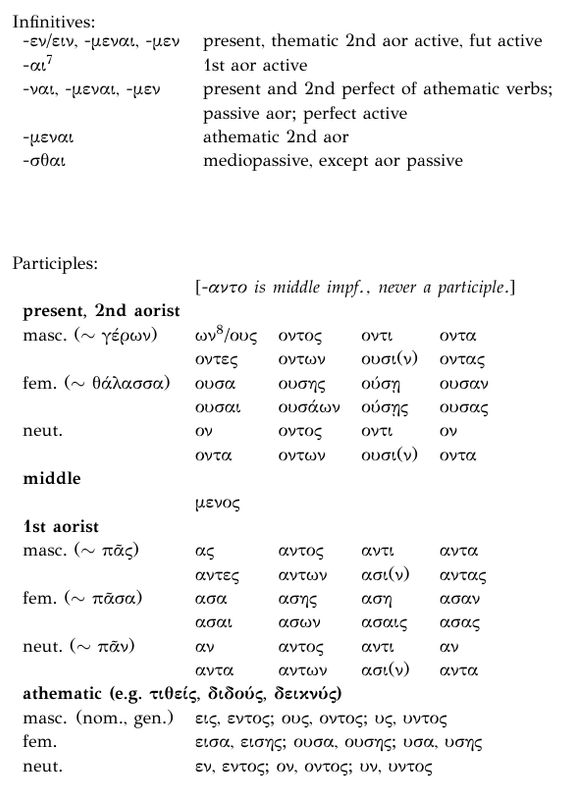
Both of these are from a software-aided presentation of the Iliad that I’m working on as an open-source project, and both are under a CC-BY-SA license. They’re for the Homeric dialect, but most things are the same as in Attic. Book: https://bcrowell.github.io/ransom/ . In most cases, participles are easy to identify because they have noun endings on a verb stem.
Whenever you’re confused or want to check yourself, you can also always just cut and paste the verb in U Chicago’s morpho utility: https://logeion.uchicago.edu/morpho
The verb ἐποιεῖτο has an augment, which tells us it’s a past tense, and a -το ending, which is a middle or passive ending for the 3rd person singular. This is a conjugated verb in the imperfect, not a participle.
The English translation you’re looking at just isn’t very literal. The subject of the sentence is Φίλιππος, and the verb with that subject is ἐποιεῖτο. A more literal translation would be “Aratus and the Achaean troops having expressed their thanks to him for this, Philip having dismissed the meeting and having departed with his army, he marched for Lasion.” The translator has not rendered it this literally because the long chain of participles would sound bad in English and be hard to understand. The use of all the participles in Greek is clearer because we have participles in two different tenses, and that conveys the information about the sequence of events that would have been unclear in a literal English translation.
BTW, what is the source of the quote?